
From Research to Market: MarginUp! Policy Insights at GBS2026
Marginal lands will not become a bioeconomy resource on available hectares alone. They need trusted land governance, market pull and policies that pull in the same direction. That was the message from MarginUp!’s policy session and workshop at the Global Bioeconomy Summit 2026 in Dublin.
After opening the summit week with its satellite event, MarginUp! moved from the field to policy and markets. On 20 October, more than 30 participants joined the lunchtime session From Research to Policy, where the project presented and discussed its policy paper and draft recommendations. On 21 October, close to 100 participants took part in the collaborative workshop From Feedstock to Market: Building the Value Chain for a Competitive Bioeconomy, co-organised by project partner ATB with Avantium, Munster Technological University, Novamont and the Renewable Gas Forum Ireland (RGFI).
From research to policy
At the lunchtime policy session, participants discussed MarginUp!’s policy paper and its draft recommendations. Speakers highlighted that marginal lands can supply raw materials for the bioeconomy while supporting rural development, biodiversity and ecosystem services. But governing them for industrial feedstock means balancing agricultural, environmental and social priorities that often conflict.
The challenge starts with the basics. There is no universal legal definition of marginal land, which leads to data gaps, fragmented rules and diverging views on what marginal land is and how it should be used. On top of that, policymakers must manage ecological trade-offs, navigate the “food versus industry” debate around indirect land-use change (ILUC), reduce investment risk, and address social acceptance and land tenure.
MarginUp!’s pilots showed that delivering several benefits at once is difficult. Crops on marginal lands can bring strong economic returns while harming biodiversity or ecosystem functions. Management focused on biodiversity, by contrast, may not pay. Policy has a central role in managing these trade-offs. It can clarify competing objectives, bring stakeholders together, reward multiple benefits and compensate losses. Yet many policies still pursue a single objective, or are poorly coordinated with one another.
To unlock the potential of marginal lands, MarginUp! proposes seven measures:
- Clarify the trade-offs of growing alternative crops on marginal lands.
- Communicate the multiple benefits and trade-offs of these crops.
- Reduce financial barriers and risks for farm businesses and value chains that deliver multiple benefits.
- Govern conflicts and remove regulatory barriers.
- Strengthen demand and market mechanisms for products from marginal lands.
- Support collaboration across marginal-land biomass value chains.
- Improve policy coherence for the multifunctional use of marginal lands.
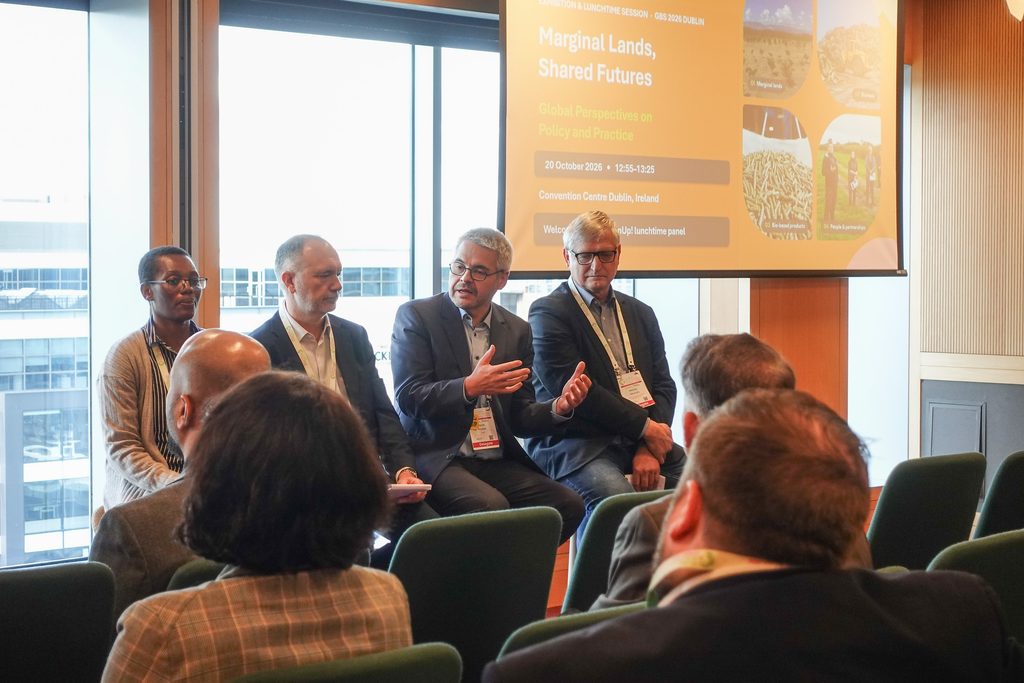
The discussion with speakers and participants added several points:
Avoid competing with food. Marginal lands can supply the bioeconomy without competing with food production, a way out of the “food versus industry” paradox.
Agree on a definition. Europe and its partners need an internationally valid definition of marginal land, with safeguards built in.
Certify pathways. Certifying marginal-land pathways would open access to green credits and other funding.
Make biodiversity benefits visible, so they can be recognised and rewarded.
Build biomass hubs to connect biomass producers with industry.
MarginUp!’s partner Duduzile Ngwenya (Researcher, Stellenbosch University) brought the South African perspective. There, current policies on invasive alien trees focus on land restoration, but the biomass cleared in the process has been largely overlooked. MarginUp!’s South African use case assesses the biodiversity and socio-economic impacts of value chains based on this biomass, such as biochar, pellets and wood chips. Using it could become a climate adaptation strategy in its own right.
From feedstock to market
The collaborative workshop turned to the question of how sustainable biomass becomes a competitive value chain, from the field all the way to the buyer.
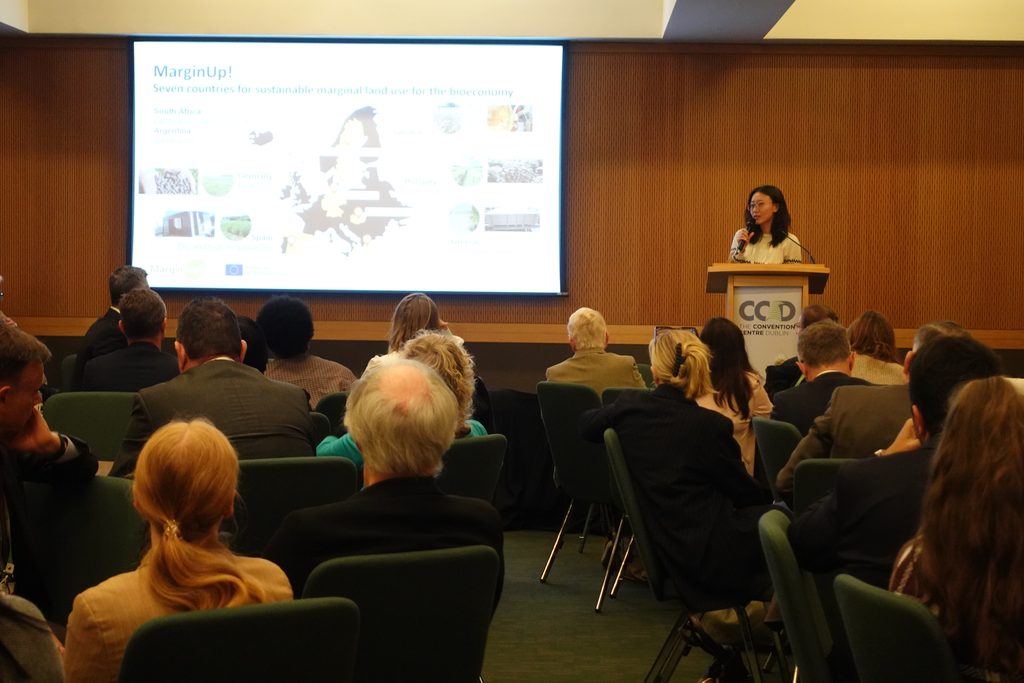
Hyunjin Park (Researcher, ATB) presented MarginUp!’s use cases and the solutions they are testing, together with their environmental assessments. The pilots delivered different biodiversity results, showing the need to keep collecting and consolidating environmental data from farms and businesses. She stressed that marginal lands will change as the climate changes, that value chains need supporting infrastructure, and that their development depends on market pull.
Michael Noctor (Education and Outreach Manager, Munster Technological University) showed how an undervalued resource can create circular bioeconomy value. Using wool as an example, he followed the value chain from farm to market, including work on assessing wool’s sustainability and the case for local processing.
Robert Shine (Managing Director, SAMCO) explained how innovation starts with farmers’ needs: crop establishment, labour costs and the weather. He described the path from research and product development, working closely with suppliers, to market scale. That path means moving from trials to production, keeping quality consistent, managing costs, building a dependable supply chain and improving continuously.
Ingrid Goumans (Director of Public Affairs & Sustainability, Avantium Renewable Polymers) focused on bio-based polymers and the conditions needed to scale up dedicated bio-based polymers on the market.
Nick Bennett (CEO, Renewable Gas Forum Ireland) presented Ireland’s agricultural strength as a natural advantage for biomethane, with the potential to turn agricultural resources into renewable energy and new economic opportunities. Ireland illustrates the workshop’s central challenge: the science and technology are proven, and industry interest exists, but investment needs bankable market demand and predictable policy.
Six lessons for scaling up
Drawing on MarginUp!’s experience, the workshop highlighted six lessons:
- Scaling up requires coordinated supply and market pull.
- Available land is a weak indicator of real scaling potential. Trust-based land governance mechanisms are needed.
- Environmental benefits do not automatically create a viable market.
- Mature technology is not the same as readiness to scale. Downstream activities need support.
- The decisive infrastructure is not necessarily complex.
- Collaboration and biomass hubs need support.
Looking ahead
Across both sessions, one idea came up again and again: the solutions exist, but they need markets, infrastructure and coherent policy to grow. The policy session showed that unlocking marginal lands starts with the basics: a shared definition, clear safeguards and policies that guide towards multiple benefits instead of working against each other. Together, the two sessions confirmed that marginal lands can supply Europe’s bioeconomy without competing with food production, if research, industry and policymakers move forward together.
The project’s tools, results and use case materials remain openly available on the Replication Hub, so that farmers, businesses and policymakers can build on what MarginUp! has learnt.
Read more: Unlocking Marginal Lands: Key Insights from MarginUp!’s Satellite Event at GBS2026
